

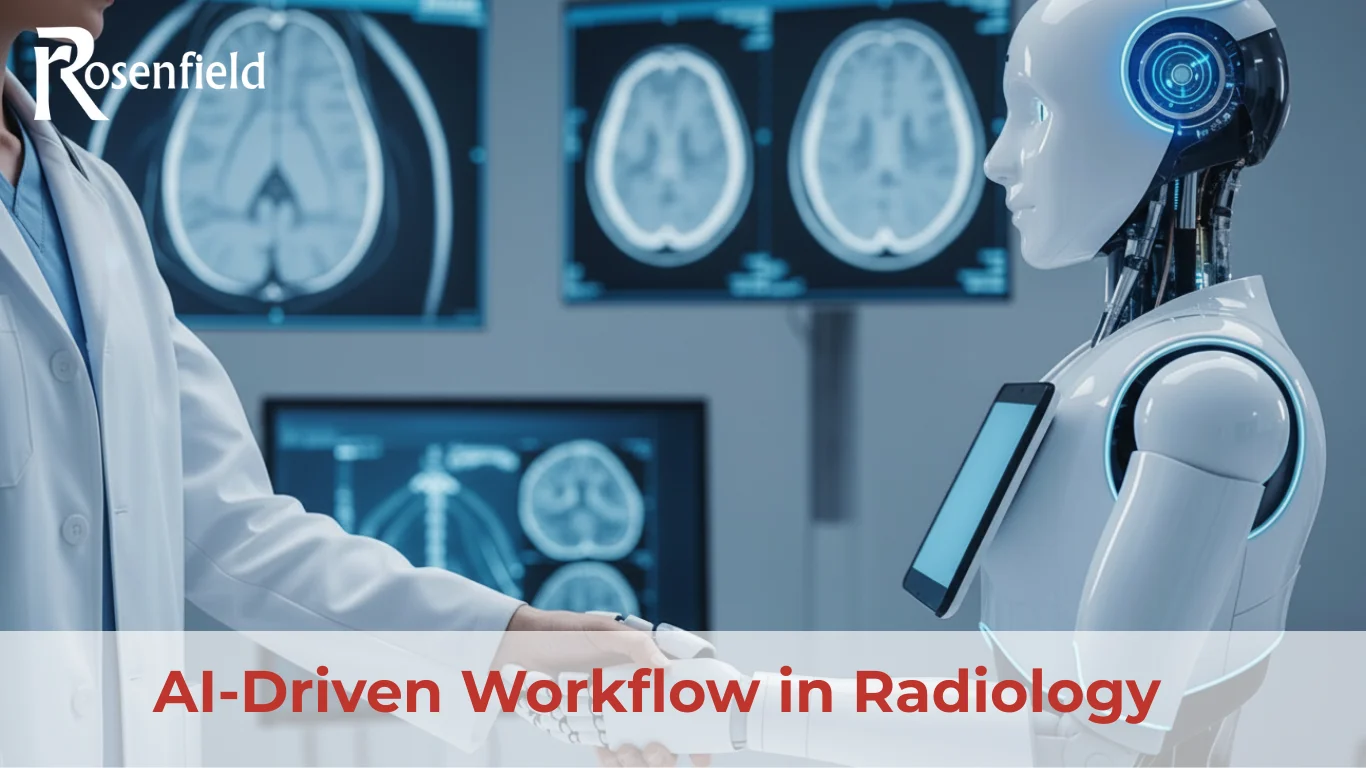
AI-Driven Workflow in Radiology
With the development of radiology technologies and the increase in population, we find that radiologists face many challenges in the fast-paced work environment. The number of imaging studies increases by about 5% each year without a parallel increase in the number of specialised doctors, which results in an accumulation and complexity of cases, and increases the level of professional pressure. This makes about 45% of radiologists vulnerable to professional burnout, and also increases the likelihood of errors in diagnosis.
This is where the idea of AI-driven workflows in radiology emerges. This technology offers a solution to improve the workflow by automatically triaging cases, analysing and organising images, which reduces the burden on doctors. Accordingly, the doctor is able to focus on the most important tasks, such as making diagnostic decisions and developing a treatment plan.
What does “AI-driven workflow” mean in radiology?
The AI-driven workflow in radiology refers to the process of integrating artificial intelligence technologies into the different work stages in the medical imaging department. These systems perform routine and repetitive tasks automatically, such as sorting studies, as well as the initial identification of emergency cases, and the preparation of reports. All of this is done without compromising the doctor’s role, as the goal of these technologies is not to replace the doctor but to support and enable them to focus on the most important tasks.
Accordingly, artificial intelligence becomes an essential part of the daily process, as we find it working smoothly in the background to speed up the workflow and improve diagnostic results. Thus, the radiology AI impact factor becomes large and pivotal, which transforms it from a mere auxiliary tool to an essential element in improving the quality of service provided within radiology departments. It also enables doctors to arrive at the appropriate treatment plan.
How AI transforms the radiology workflow stages
Artificial intelligence significantly facilitates the workflow within the radiology department in all stages of imaging, from taking the image to creating the final report. The following is an explanation of this:
- Image Acquisition Stage: We find that artificial intelligence contributes to automatically adjusting the settings of the radiology device and speeds up the process of capturing images, while improving the image quality, and accordingly, making it easier to reach the correct diagnosis.
- Worklist Distribution and Triage Stage: Advanced systems analyse the studies upon their arrival, as well as identify emergency cases such as stroke and make them a priority that needs quick handling. They also direct the examination to the most appropriate doctor, which saves the patient time and effort.
- Image Reading and Analysis: Artificial intelligence algorithms work to read the images and identify suspicious areas in them, as well as determine the automation of segmentation, which preserves the quality of the image and reduces the manual work of the doctor in these parts, which increases the accuracy and ease of the workflow.
- Reporting: The role of AI in radiology reporting is highlighted in the ability of these tools to automatically convert voice dictation into formatted reports, with the placement of measurements and standardised language, which reduces the chance of errors and speeds up the process of preparing reports.
- Follow-up Detection: Here, NLP systems scan previous reports, identify recommendations that have not been implemented, and set alerts to ensure continuous follow-up, which improves the continuity of work in a smooth and accurate manner.
Benefits of AI-driven workflows: speed, accuracy, decision support
The AI-driven workflow in radiology and other specialties is characterised by several important advantages that save a lot of time and effort, such as:
Increased speed and reduced response time
AI contributes to completing routine tasks, which reduces the time wasted between capturing the image and issuing the report. Some Trusts have recorded a significant decrease in the time consumed in diagnosing critical cases, to the point where they can be diagnosed in less than 15 minutes, which has an excellent impact on saving patients and preserving their health.
Enhanced diagnostic accuracy and consistency
Artificial intelligence has been trained so that its algorithms are able to perform an additional review of the image, which helps in detecting fine details that the doctor may not notice. This reduces the rates of false positives and false negatives in the diagnosis of sensitive diseases such as breast cancer.
Decision support and reduced cognitive load
AI takes over administrative tasks, manual measurements, and report reviews, which allows the radiologist to focus on clinical analysis, which reduces the burden on the doctor and increases the accuracy of the final reports.
Precision medicine and prediction of results
AI, using radiomics techniques, can extract hidden quantitative features from images and adjust them with clinical and genetic data to predict the course of the disease and the result of the response to treatment.
Integration challenges: legacy systems & interoperability
With this development in the technologies used in the field of radiology, there are challenges in integrating and linking the systems used, such as:
Difficulty in integrating AI with legacy systems
Despite integration challenges, studies show that future radiology departments will rely on interconnected systems. AI will be an essential partner, enhancing diagnostic efficiency and improving treatment planning.
The need for interoperability and ease of use
In order for integration to be successful, the artificial intelligence systems must work smoothly within the already used image viewer, without any changes to the daily routine, which makes cooperation between system vendors and IT teams a necessity.
Beyond the Hype: Moving from “Point Solutions” to Orchestration
In previous years, many departments fell into the trap of “AI Fatigue” by adopting too many separate, disconnected tools. The future lies in AI Orchestration solutions. This means moving away from “swivel-chair interoperability”—where doctors have to log into different portals—toward a unified layer that sits between your PACS providors and EHR. Effective integration must leverage standards like DICOM Anonymisation Tools, HL7, and FHIRcast to ensure that data flows seamlessly. Rosenfield Health focuses on being “vendor-neutral,” ensuring that AI becomes a background ally rather than a technical hurdle.
The cornerstone: anonymous data and its role in enhancing artificial intelligence
Anonymising data is the cornerstone in the development of artificial intelligence solutions within radiology departments. These algorithms require the availability of large collections of high-quality images to be trained on, but collecting this data may affect the protection of patient privacy, which makes the anonymisation process important.
Here, the importance of advanced tools such as BriX emerges, which simplifies this complex task by processing many studies in a short time, while ensuring the removal of any identifying information related to the patient. This makes these tools essential for developing the new generation of artificial intelligence algorithms efficiently without compromising patient privacy.
Case studies: AI workflows in imaging departments
Studies show how the AI driven imaging workflows contribute to a real transformation within radiology departments. In one example, a global company developed a platform capable of analysing CT scans upon their arrival to detect critical cases such as brain hemorrhage, which led to a reduction in diagnosis time by about 20%. In another example, we find that artificial intelligence solutions have helped in analysing images and prioritising cases, which has increased the productivity of doctors.
We also find that these solutions have contributed to reducing the time consumed in diagnosing lung diseases by up to 30%. In another example, we find that advanced screening technologies have proven their effectiveness, as in cooperation with the NHS in detecting breast cancer, which reduced false positives by 5.7% and false negatives by 9.4%.
Best practices when implementing AI workflows in radiology
The AI-driven workflow in radiology requires several requirements to ensure the best results, such as:
Ensuring data quality and diversity
The good application of these tools requires investment in strong mechanisms that collect and unify data to ensure that these algorithms are trained on diverse sources, which reduces bias and provides reliable performance in various cases.
Prioritising seamless integration
Artificial intelligence solutions must be chosen that integrate easily with PACS and RIS systems without adding complex steps, which contributes to improving the quality of work with ease.
Involving radiologists in every stage
The participation of doctors in evaluating and deploying these tools makes them accept them as a clinical support for them and not a tool that threatens their future, which enhances the trust of doctors.
Adherence to regulations and ethical standards
The success of any artificial intelligence solution depends on protecting patient privacy, ensuring transparency in the performance of the algorithms, and setting clear limits for the use of these tools.
Benefiting from global trends
Reports by international institutions such as the role of AI in radiology RSNA indicate that the most successful institutions are those that integrate artificial intelligence into their work strategy, not just use it as a separate tool.
Proving ROI: The “Prove It” Phase of Radiology AI
As we move through 2026, healthcare leadership (CFOs and Clinical Directors) requires more than just clinical promises; they require a Return on Investment (ROI). Implementing AI-driven workflows has shown a measurable impact:
-
Reduced Turnaround Time (TAT): Cutting emergency diagnosis times by up to 20%.
-
Productivity Gains: Increasing case throughput by roughly 11-15% without increasing staff hours.
-
Error Mitigation: A 42% reduction in diagnostic errors in trusts using AI-supported diagnostics. By focusing on these “Hard Metrics,” your facility can justify the digital transformation budget while significantly improving patient outcomes.
Conclusion
With the acceleration of technological development and the reliance of Trusts on more intelligent advanced solutions, the AI-driven workflow in radiology has become a pivotal step. It works as a support for the doctor and does not replace him, which enhances the role of the doctor and the accuracy of his work. Accordingly, the quality of care increases and diagnostic errors decrease. Despite the challenges associated with the integration between systems, studies indicate that the future of radiology departments will be shaped by more interconnected systems, which makes the use of artificial intelligence an essential partner that raises the efficiency of diagnosis and improves the quality of the diagnosis and the treatment plan directed to the patient.
By 2026, these intelligent workflows are expected to stand at the heart of radiology departments worldwide, serving as a deeply rooted ally that accelerates decision-making, enhances accuracy, and brings the diagnostic experience closer to the patient and their needs.
The future of radiology starts with intelligent integration. Contact us at Rosenfield Health to begin your transformation journey.
FAQs About AI-Driven Workflow in Radiology
What is an AI-driven workflow in radiology?
It is the process of integrating artificial intelligence tools into the various stages of the imaging process and report writing within radiology departments, with the aim of reducing the administrative burden and routine tasks, which enables radiologists to work faster and with higher accuracy.
Can AI workflows reduce diagnostic errors?
Yes, the AI-driven workflow in radiology can reduce diagnostic errors, as the algorithms act as a second reader, capturing fine details that the doctor may miss due to work pressure. It also provides a consistent level of consistency with reports, which enhances the accuracy of the diagnosis and accordingly, the development of the appropriate treatment plan for the patient.
